

When purchasing an investment property, it is common to buy under an individual's name, but there can be greater benefits in some cases if purchased under a Company, Trust, or SMSF (Self-Managed Super Fund).
Since real estate purchases are generally long-term investments, and changing ownership later incurs significant costs, here are some considerations when buying an investment property.
1. Income Tax
Investment properties generate income, and the net profit after expenses is subject to income tax by the owner.
- Individual: The net profit is added to the individual's income and taxed accordingly. As of the 2025 financial year, if the individual's income from other sources exceeds $135,000, the property income will be taxed at 39% (including Medicare Levy). If the other income exceeds $190,000, the property income will be taxed at 47% (including Medicare Levy).
- Company: The net profit from the property is taxed at a fixed rate of 30% or 25%. However, the tax paid by the company is not final, and shareholders can recover the tax paid through dividends and franking credits.
- Trust: The net profit is distributed to the beneficiaries, who then pay income tax on their share. If a family member has a low income, the distribution can reduce taxes, but if family members have significant other incomes, the tax-saving effect may be limited.
- SMSF: The net profit is taxed at a fixed rate of 15%. If the SMSF is in pension phase after retirement, the income from the property can be entirely tax-exempt.
2. Capital Gains Tax
When selling a property, the difference between the purchase price and the sale price is subject to Capital Gains Tax (CGT).
- Individual: The capital gain is added to other income and taxed accordingly. If annual income exceeds $190,000, the excess is taxed at 47% (including Medicare Levy). However, if the property is held for more than 12 months, a 50% CGT discount applies.
- Company: Capital gain is taxed at a fixed rate of 30% or 25%, and the 50% CGT discount does not apply, even if held for more than 12 months. The tax paid by the company is not final, and shareholders may recover it through dividends and franking credits.
- Trust: The capital gain is distributed to the beneficiaries, who pay CGT on their share. If family members have low income, the distribution can reduce taxes, but if they have significant other incomes, the tax-saving effect may be limited. The 50% CGT discount applies if the property is held for more than 12 months.
- SMSF: The capital gain receives a 33.33% CGT discount, and the discounted amount is taxed at 15%. If the SMSF is in pension phase after retirement, the capital gain can be entirely tax-exempt.
3. Land Tax
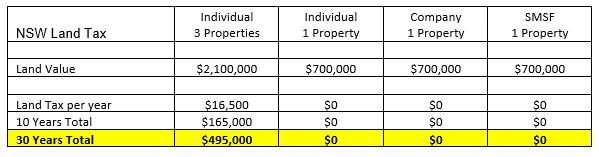
If the land value of the investment property exceeds a certain amount, the land tax must be paid to the state government. For individuals owning multiple properties, the land tax is calculated based on the total land value, leading to higher taxes as the total land value increases.
- Company/Trust/SMSF: Each entity has separate land tax thresholds, which can significantly reduce land tax compared to an individual owning multiple properties.
For example, if an individual owns three properties with a total land value of $2,100,000 in NSW, they would pay $16,500 annually in land tax, totalling $495,000 over 30 years. If the properties are held separately by an individual, a company, and an SMSF, land tax can be avoided.
Note: Land tax criteria vary by state.
4. Travel & 2nd Hand Asset Deductions
Since 2017, expenses related to travel for inspecting residential investment properties are no longer deductible. However, if the property is purchased under a company name, travel expenses for inspections, repairs, etc., are deductible, including airfare, meals, and accommodation.
Also, since 2017, deductions for second-hand assets in investment properties are not allowed. However, if the property is purchased under a company name, deductions for existing and newly purchased second-hand assets are allowed.
5. Asset Protection
When purchasing property under an individual's name, the properties are not protected in cases of personal bankruptcy or other unforeseen circumstances.
If a Company, Trust, or SMSF owns the property, it could be protected in the event of personal bankruptcy or legal disputes.
5. Borrowing Power
When financing a property purchase, owning multiple properties under an individual's name can limit the ability to secure further loans. Using a company, trust, or SMSF can enable additional property investments, but if the individual's borrowing power is already maxed out, it may not be feasible to purchase through these entities. Therefore, it is advisable to seek expert advice if planning to buy multiple properties.
Disclaimer
This material has been prepared for information purposes ONLY, and is not intended to provide, and should not be relied on without Tax/Accounting/Legal/Financial/Credit advice from a relevant qualified adviser.